
Building a Social Innovation Cluster in Knowsley
Jacqui Meadows is the founder of Capacity for Change and describes herself as its ‘Chief Empowerment Officer’. She came together with other socially-trading organisations and creative freelancers as part of the Women in the Know group, following Kindred’s work in the borough in 2023.
Two years later, Jacqui took the lead on a pop-up shop in Kirkby town centre, designed as a place to grow and support the social sector, acting as a base for socially-trading organisations – many of them, in Jacqui’s words – “really in their infancy… to come and test their product or idea.” Capacity for Change provided the advice and guidance to move people from idea to structure.
In just eight weeks, Jacqui delivered six sessions and worked with eight clients: helping people move from informal activity towards structure, alongside a range of activities designed to test ideas other creative and care-focused organisations: “Two groups adopted constitutions and have governance documents now, so they can access funding and start delivering." One CIC – Teen Souls – emerged directly from this support, supporting teenagers’ mental health through self-care and confidence-building activities.
Though often overlooked as productive activity, shared creative spaces generate the connections and trust that underpin future social and economic outcomes. This is the cluster’s pattern – low-barrier, hands-on support that takes someone from an idea to a constituted organisation capable of attracting funding.
Connection
The shop didn’t just support people already heading towards entrepreneurship – it highlighted needs that weren’t yet visible. A games evening, modest in scale (three sessions, four families, ten individuals), exposed a sharper picture of local isolation: children either hanging out on the streets or alone “in their bedrooms, scrolling the internet, with no social interactions whatsoever,” Jacqui says.
For one young girl who wouldn’t speak to anyone outside her family, two sessions of board games were enough to start her re-engaging socially; she has gone to attend an art session in the town regularly. “That was a quick, early intervention for me,” says Jacqui. “She was clearly a very smart girl, but she just struggled in social settings.”
Programmed sessions like card-printing, clay and somatic yoga created the conditions for people to find each other. A sole trader running menopause support and a woman doing mental health workshops were able to link in and do a workshop together – connections that wouldn’t have happened without the shared space.
This connective tissue extends beyond the shop itself. Jacqui describes setting up Teen Souls’ founder with space to deliver her programme: “I introduced her to someone who runs a socially-trading day service and now she’s supporting her with space for her CIC. It’s organic,” she says. The cluster doesn’t just create individual interventions – it creates a web of mutual support that continues to generate new connections long after the initial activity ends.
Sustaining and scaling the model
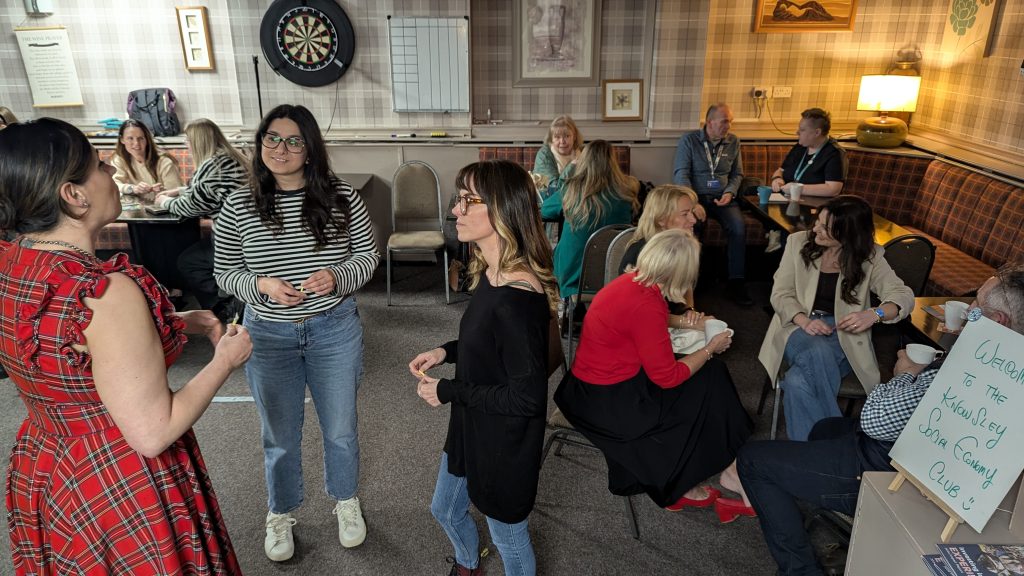
The community that came together as part of Women in the Know has lasted beyond the shop itself, sustained through a WhatsApp group of around 30 members and a regular Social Economy Club with partner Fran Manca at Underwing Liverpool. Members are encouraged towards other opportunities in the wider ecosystem – like pitching at Liverpool Soup – and, in partnership with the Eleanor Rathbone Trust, Capacity for Change will be delivering series of workshops on how to set up and run socially trading and community organisations.
“In the Social Economy Club, people have found a network who understand what it’s like to run a business like theirs – running a socially-trading organisation (STO) alone can be hard and lonely,” says Fran. “What’s brilliant is that these sessions aren’t about selling: they’re informal, relaxed conversations and yet people leave having made new connections, decided to work together, even come away with a sale or a collaboration. We’ve already seen three business transactions come out of two SECs in the borough. It’s proof that the value isn't in the pitch, it’s in being in a room with peers who get it.”
This matters because, as Jacqui notes, “STOs often describe how isolated they are – not just in terms of geography, but with everyone working in silos.” The cluster’s value lies precisely in countering that: “It’s not just about sharing information, but about coming together and saying ‘we’re all here and we can all help each other’.”
“So many of the people who come to the Social Economy Club spend their working lives supporting others: signposting, solving problems, providing for people in need,” adds Fran. “What they forget is that no one’s doing that for them. That’s why the wellbeing side matters – not necessarily as the main event, but always there. Even people who say they’re coming along to ‘have a break’ end up having the best business conversations, because for once they’ve got the capacity and the space to talk about their own business, and everyone who was there has taken them seriously.”
The two also highlight the value of their own working relationship, which has blossomed through running Social Economy Clubs together – they are collaborating and planning new ways of supporting the sector to thrive. Next, they are looking at ways to make this permanent – an ecosystem, rather than an intervention – with Jacqui looking for funding to create a permanent socially-trading hub in the town centre, building on what the shop proved was possible.